
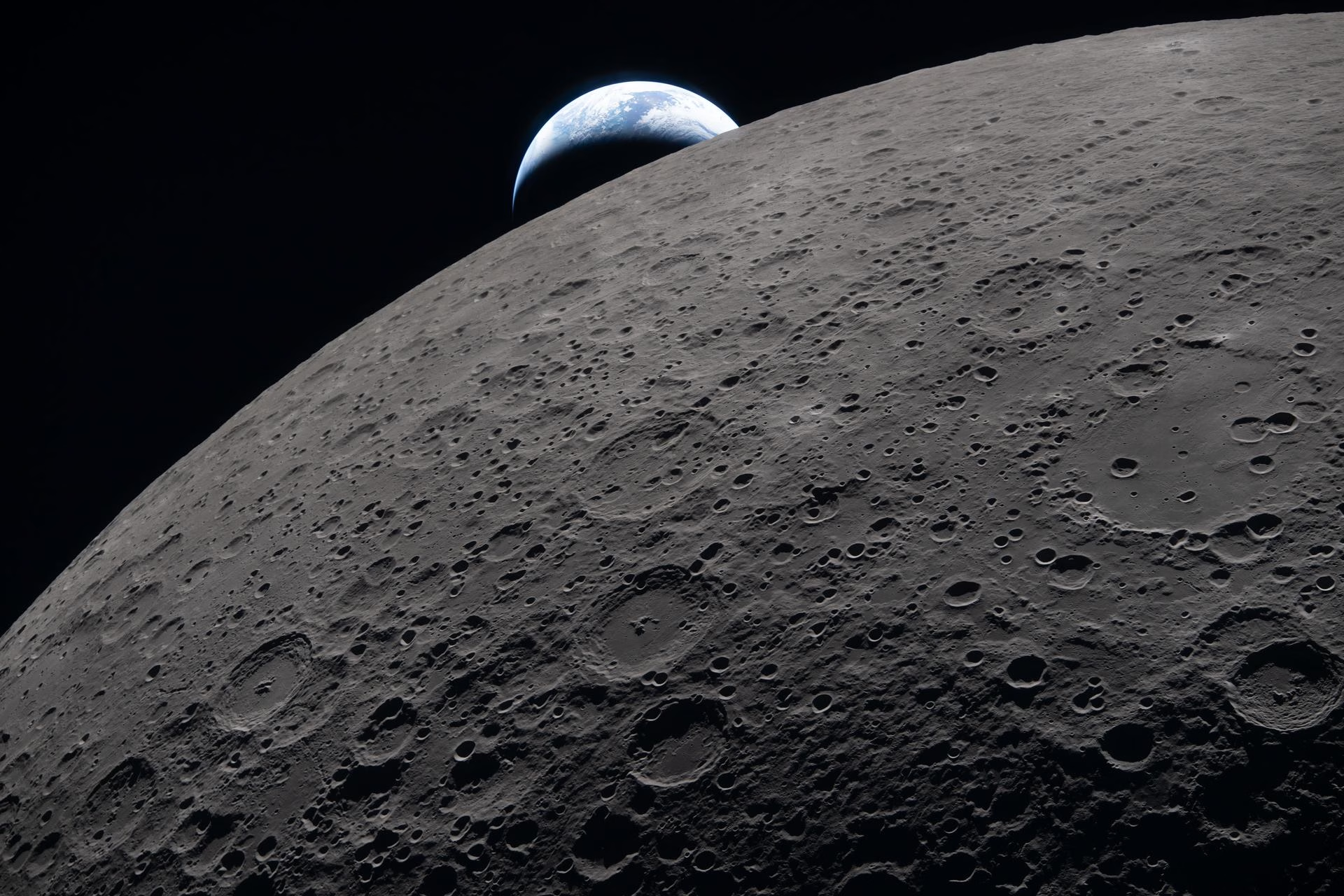
NASA’s Artemis II mission brought fresh attention back to the Moon after the crew splashed down on April 10, 2026, following a nearly 10-day lunar flyby. That mission did not land astronauts on the Moon, but it did reinforce a bigger point. The Moon is once again central to the future of spaceflight.
Helium 3 and the New Lunar Business Case
A big reason is helium-3. It is a rare isotope with real value on Earth today. The U.S. Department of Energy says helium-3 supports government research, national security activities, and medical diagnostic procedures. DOE also notes that helium-3 plays a critical role in some quantum computing cooling systems and remains so rare that the federal government closely manages its supply.
That matters because the current business case is not only about future fusion. It is also about present-day demand. In quantum computing, some platforms rely on dilution refrigerators that use helium-3 and helium-4 to reach extremely low temperatures. That gives helium-3 immediate commercial relevance, even before any large-scale fusion future arrives.
The Moon as a Resource Environment
The Moon matters because its surface has been exposed to the solar wind for billions of years. According to the U.S. Geological Survey, helium-3 in lunar regolith depends on surface maturity, solar wind exposure, and titanium content. Ilmenite-rich areas are especially important because this mineral retains helium better than other major lunar minerals.
This does not mean the Moon is ready to become an instant energy solution. It does mean that the science behind lunar helium-3 is sufficiently robust to support commercial interest and mission planning. For aerospace companies, the Moon is more than a symbol of exploration. It becomes a potential resource environment.
Commercial Momentum Is Building
The commercial side is already taking shape. In May 2025, Interlune announced that the U.S. Department of Energy Isotope Program agreed to purchase three liters of helium-3 harvested from the Moon, with delivery targeted no later than April 2029. Interlune also announced a supply agreement with Maybell Quantum, which plans to use helium-3 in dilution refrigerators for quantum systems. These are announced agreements, not completed lunar production, but they show that the market is moving from theory toward early demand signals.
The supporting mission infrastructure is also becoming clearer. Interlune has announced plans to fly a multispectral camera on Astrolab’s FLIP rover to estimate helium-3 concentrations in lunar regolith, and the company says the payload was developed with NASA Ames. Separately, ispace and Magna Petra announced an agreement to carry NASA’s MSOLO instrument to the lunar surface to gather data on helium-3 and other volatiles.
What This Means for Aerospace
The larger shift is easy to see. The Moon is no longer only a destination. It is increasingly being treated as infrastructure, data, logistics, and resource potential. Artemis has restored momentum at the government level, while private companies are now trying to build the prospecting and support systems that could define a future lunar economy.
For aerospace media, that is the real story. Helium 3 on the Moon sits at the intersection of exploration, technology, and commercial strategy. That makes it one of the clearest examples of how lunar activity is shifting from prestige to business.