
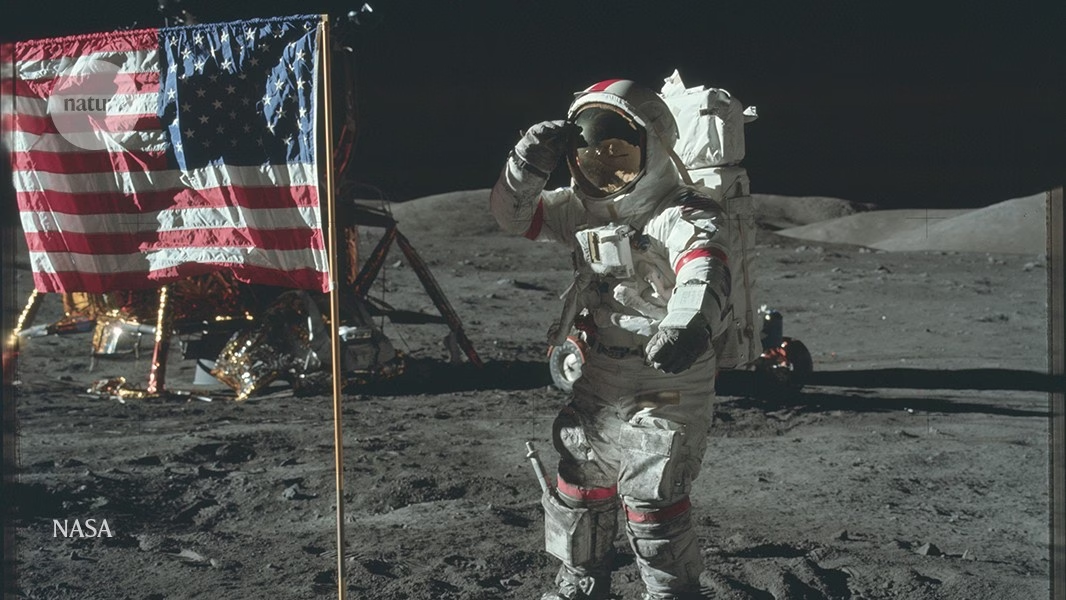
The United States did not stop going to the Moon because it lost the ability to get there. It stopped because Apollo was never just a scientific project. It was a Cold War mission shaped by politics, prestige, and money.
In the 1960s, the space race gave the Moon enormous symbolic value. The Soviet Union launched Sputnik in 1957 and sent Yuri Gagarin into space in 1961. The United States answered with Mercury, Gemini, and then Apollo. Going to the Moon became a test of national power as much as scientific ambition.
The political goal had been achieved
Apollo had a clear purpose. The United States wanted to prove that it could surpass the Soviet Union in the most visible technological contest of the age.
That goal reached its peak in 1969 when Apollo 11 landed on the Moon. After that, the political urgency began to fade. America had made its point. Repeating the feat did not carry the same value it once had.
Apollo cost an extraordinary amount of resources
Apollo was one of the most expensive government programs of its era. It required massive rockets, complex spacecraft, huge support teams, and years of testing and development.
That kind of spending made sense during the height of the Cold War. It became much harder to defend once the United States had already won the race. As public attention shifted and other priorities took over, support for repeated lunar missions weakened.
Apollo 13 contributing factor
Many people assume Apollo 13 ended America’s lunar ambitions. It did not.
Apollo 13 was a serious crisis, but it was not the main reason the United States stopped going to the Moon. The deeper issue was that Apollo had already become harder to justify politically and financially. The program had done what it was built to do. After that, momentum declined.
Robots made more practical sense
Human missions are expensive because humans need life support, protection, and a safe return home. Machines do not.
That difference changed space exploration. Uncrewed missions could stay longer, cost less, and take on scientific work without the risks of human flight. For many goals, robotic exploration offered a far more efficient path.
The mission changed
The Moon did not become irrelevant. The reason for going simply changed.
During Apollo, the Moon was a finish line in a geopolitical race. Later, space agencies focused more on robotic science, low Earth orbit, and long term research. In recent years, interest in the Moon has returned for different reasons, including science, strategy, and preparation for deeper space missions.
The simple answer
America stopped going to the Moon because the Cold War logic behind Apollo did not last. Once the United States achieved the goal, the political will faded and the cost became harder to justify.
It was not a failure of technology. It was a change in priorities.
References
The Planetary Society: How much did the Apollo program cost?, NASA: Apollo 17, NASA: Apollo 13, The Successful Failure, PEOPLE: Why Haven’t Astronauts Returned to the Moon in 50 Years? Inside the Technical and Financial Challenges, NASA: Moon to Mars Strategy and Objectives,